

Copper in Dog Food: Why It’s More Complicated Than You Think
Recent social media posts warn that “millions of dogs are in imminent danger” from copper in commercial pet food. Those posts are tapping into a real scientific debate, but they often miss critical nuance: copper is essential, some dogs are clearly being harmed by excess copper, and at the same time we genuinely do not know the optimal copper range for every dog. Here we will walk through what we do know from peer‑reviewed research, where the uncertainty lies, and how pet owners can make informed decisions without the panic and fear‑mongering driven by social media.
1. Copper Is Essential and a “Goldilocks” Nutrient
Copper is an essential trace mineral involved in many everyday body functions: using iron to make healthy red blood cells, building strong bones and joints, keeping the immune system working, and protecting cells from damage. Dogs cannot synthesize copper on their own, so they must obtain it from food. Too little copper can lead to anemia, weak bones and connective tissue, poor growth, and changes in coat color or quality. A key point is that trying to avoid copper altogether is not a solution. Fortunately, true copper deficiency is rare in dogs eating “complete and balanced” diets that meet basic nutritional standards.
Copper works by enabling many enzymatic “worker proteins” to function properly. It acts like a key that turns certain enzymes “on,” supporting energy production, iron utilization, healthy connective tissues, normal pigmentation, and antioxidant protection. When copper is insufficient, these systems begin to struggle; when it is excessive, the liver can become overwhelmed by stored copper.
Copper is also a redox‑active metal, meaning that at high concentrations it can drive oxidative injury, inflammation, scarring (fibrosis), and eventually cirrhosis. In dogs, cirrhosis is an end‑stage liver change that can result from many chronic liver diseases; one important subset involves copper‑associated hepatopathy (CAH), also called copper‑associated chronic hepatitis.
Because too little is problematic and too much can be damaging, copper is best thought of as a “Goldilocks nutrient”: not too little, not too much, but a just‑right amount for that individual dog. Genetics, liver health, and the rest of the diet can all shift where that “just right” range falls. This factor is one of the many reasons nutrition is far more nuanced than “more is always better” or “less is always safer.” This complexity also explains why setting a single strict upper limit for copper that fits every breed and every dog is genuinely difficult. The fact is that some individuals may need more copper to support essential body processes, while others with copper‑handling defects can be harmed by amounts that are perfectly safe for most dogs.
2. What the Research Actually Shows
Rising Hepatic Copper Over Time
Over the past 30–40 years, multiple biopsy‑based studies have documented a clear upward trend in liver copper concentrations in dogs. Critically, this is not limited to breeds historically considered at risk for CAH; it is a broader, population‑level finding confirmed across several peer‑reviewed publications:
- In a 546‑dog archive spanning 1982–2015, median hepatic copper concentrations roughly doubled between the 1980s and the late 2000s. In the same study, the proportion of dogs with markedly increased copper (>1,000 μg/g dry weight) increased approximately threefold (1).
- A large pathology series of 4,559 dogs published in 2022 found that half of all liver samples had copper concentrations above 400 ppm (the upper end of many reference ranges), and 19% exceeded 1,000 ppm. Higher copper was associated with more severe inflammation and necrosis, and with certain breeds (Doberman Pinscher, Labrador Retriever, West Highland White Terrier) (2).
- A 2025 comparative review linking canine CAH to human Wilson disease highlighted that copper accumulation is now recognized across a broader range of breeds than the classic Bedlington Terrier — underscoring both genetic and environmental (dietary) contributors (3).
These are not fringe findings. They come from multiple institutions and journals and consistently show that more dogs have higher hepatic copper than in past decades.
Limitations of the Biopsy Data
That said, (warning, this is a little technical, but important) the biopsy data we have come primarily from referral hospitals and pathology archives. This means samples are biased toward dogs sick enough to be biopsied and not a random sampling of the general pet dog population.
Additional technical factors matter too. For example, copper distribution across the liver tissue is often uneven (e.g., centrilobular vs. periportal). This means that the site and size of the biopsy can affect the measured concentration. The method of which the copper is measured can also give varied results. For example, histologic stains such as rhodanine are useful for semi‑quantitative (not exact measurements) screening but can under‑ or over‑estimate copper compared with other methods with true quantitative assays (AAS/ICP‑MS).
Together, these factors show just how complicated this problem is, but that investigating it is also complicated, and nuance. We do know that the documented rise in hepatic copper is a real signal, but it does not directly tell us the true prevalence of copper‑associated disease in the general dog population.
3. Breed‑Specific and Individual Risk
Breeds with Inherited Copper‑Handling Defects
Several breeds carry a markedly increased risk of CAH due to inherited defects in hepatocellular (liver) copper handling and biliary excretion. Bedlington Terriers are the classic example: an autosomal recessive deletion in the COMMD1 gene impairs copper excretion, leading to extreme hepatic copper accumulation (often >10,000 μg/g dry weight) and progressive hepatitis and cirrhosis if untreated. Even within this breed, genetic testing and selective breeding have reduced but not eliminated disease prevalence, and additional ATP7B variants have been described in some affected dogs.
Other breeds showing a strong association with abnormally high hepatic copper and copper‑associated chronic hepatitis include:
- Labrador Retrievers
- Doberman Pinschers
- West Highland White Terriers
- Dalmatians
- Welsh Corgis
- Cavalier King Charles Spaniels
In Labradors and Dobermans, familial clustering and centrilobular copper accumulation patterns support a heritable defect in copper metabolism, likely involving variants in copper transporters such as ATP7A/ATP7B or related regulators which interact with environmental (dietary) copper exposure. Notably, some breeds such as Bloodhounds may have lower‑than‑expected hepatic copper, emphasizing that both genetic susceptibility and diet shape individual risk (5)
Why One Cutoff Doesn’t Fit All Breeds
Historical and more recent data both show that median “normal” hepatic copper is not identical across breeds. Studies have reported significantly different mean liver copper concentrations in Doberman Pinschers, Cocker Spaniels, Keeshonds, and West Highland White Terriers compared with mixed‑breed dogs; West Highland White Terriers in particular show a very wide, continuous range of values. This has led investigators to question whether a single numeric upper limit of normal (e.g., 400 ppm or 1,000 ppm dry weight) is appropriate for all breeds, versus moving toward risk‑stratified thresholds that consider breed, age, lesion pattern, and clinical context. Current cutoffs are pragmatic rather than biologically universal.
4. Primary vs. Secondary Copper Accumulation
Copper‑associated hepatopathy is classically described as a primary storage disease in which copper itself is the main driver of hepatocellular injury, inflammation, and fibrosis. However, excess hepatic copper can also accumulate secondarily in many chronic liver diseases that impair bile flow or hepatocellular function, including cholestatic disorders and chronic hepatitis of other causes. In such cases, copper may exacerbate damage but is not necessarily the initiating cause.
Distinguishing primary CAH from secondary copper accumulation based on a single biopsy can be challenging. This is why most hepatologists emphasize integrating quantitative copper measurements, lesion pattern and distribution, clinical history, and when available genetic information before labeling a case as “primary copper‑associated hepatopathy.”
5. Diagnosis Requires More Than a Blood Panel
Serum ALT, ALP, bile acids, and ultrasound can suggest liver disease, but they cannot reliably distinguish copper‑associated hepatopathy from other hepatopathies, nor can they quantify hepatic copper burden. The current diagnostic gold standard for CAH is histopathologic evaluation of a liver biopsy combined with quantitative measurement of hepatic copper on a separate sample from the same liver.
Rhodanine staining on biopsy or cytology can screen for increased copper and correlates moderately with quantitative values, but it does not replace a true numerical copper concentration when treatment decisions (such as chelation therapy and strict dietary restriction) are being made. Repeat biopsies with quantitative copper can be useful to monitor treatment response in severely affected dogs, because serum liver enzymes alone may lag or incompletely reflect changes in hepatic copper stores.
6. Is Diet to Blame? What We Know and Don’t Know
Evidence Supporting a Dietary Contribution
Several lines of evidence implicate diet as a contributing factor. The temporal increase in hepatic copper coincides with regulatory and formulation changes that increased dietary copper and its bioavailability (for example, greater use of highly bioavailable copper chelates and supplements, and reduction of dietary antagonists such as certain fibers and minerals) (4). In dogs with copper‑associated liver disease, low‑copper diets and copper chelation can reduce hepatic copper and improve clinical outcomes, implying that ongoing dietary intake is driving the accumulation. A 2021 JAVMA viewpoint by Center et al. argued that copper content in many commercial dog foods appears to exceed biological requirements for some dogs and may surpass tolerance in copper‑sensitive individuals, and called for AAFCO to re‑establish a maximum copper concentration in its nutrient profiles (4).
What We Still Don’t Know
These data are not “smoking gun” controlled trials in which normal dogs are fed different copper levels for years and prospectively tracked for liver disease. This is because those studies do not exist. Other variables influence risk: genetics, nutrient interactions, copper in the water source, environmental exposures, chronic hepatitis of other causes, and overall liver health. In many dogs, copper accumulation may be one important piece of a multifactorial puzzle rather than the sole cause of disease. It is more accurate to say that diet is a plausible and likely contributor, but not the only one. Focusing on a single cause risks oversimplifying a genuinely complex disease process.
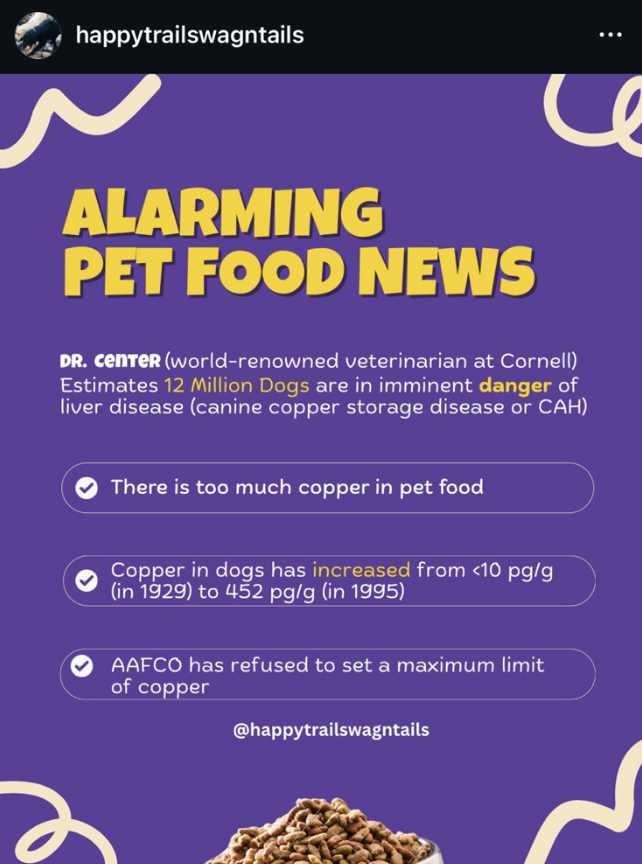
Image retrieved February 25, 2026 via @happytrailswagntails Instagram feed. It should be noted that this account has paid partnerships and/or affiliate links with multiple pet food brands that do not third‑party test for copper prior to releasing each lot into the marketplace, and do not provide those reports publicly.
7. AAFCO, Copper, and the Limits of Minimum Standards
As we emphasize consistently at NorthPoint, AAFCO nutrient profiles are designed to define minimum levels to prevent overt deficiency. These profiles are not designed to define optimal intake for every nutrient, breed, or life stage. Copper is a textbook example of that gap.
AAFCO’s Dog Food Nutrient Profiles currently specify minimum copper requirements but do not include a numeric maximum for adult maintenance diets. In their 2021 paper, Center et al. proposed a range of 0.9–1.1 mg Cu per 1,000 kcal and urged AAFCO to re‑establish a maximum and restrict supplemental sources to copper oxide (4). In response, AAFCO convened an expert panel to review the literature; the panel acknowledged the rising hepatic copper data but concluded there were insufficient controlled toxicity data to set a scientifically defensible maximum that would apply to all dogs.
The panel’s review of older toxicity studies suggested that the no‑observed‑adverse‑effect level could fall somewhere between roughly 28–31 mg and 112–124 mg Cu per 1,000 kcal. It’s important to emphasize that this is an extremely wide range reflecting limited data. The panel argued that selecting a single number would be somewhat arbitrary and might falsely reassure consumers that any diet below that value is “safe” for all dogs.
In parallel, the AAFCO Copper Claim Workgroup reviewed whether to allow label claims about copper content and concluded that “low copper” wording could easily mislead consumers into thinking a food is below minimum requirements or inherently safer for all dogs. The workgroup explored a voluntary “controlled copper” claim tied to specific upper limits (e.g., 15 mg/kg dry matter and 3.75 mg/1,000 kcal), but even this was contentious. Some members and industry groups argued these values are not proven to benefit dogs with or at risk for CAH, and raised concerns that manufacturers might cluster around the new target range in ways that are not ideal for all life stages.
For comparison, the European body FEDIAF does set a maximum of approximately 28 mg/kg dry matter. However, notably this limit is driven largely by environmental concerns about copper excretion rather than canine health endpoints.
These regulatory decisions highlight how much of the nutritional conversation is built on incomplete evidence and differing priorities. Copper illustrates why “AAFCO‑compliant” should be viewed as a baseline, not a guarantee of optimal or ideal nutrition for every individual dog.
8. How Serious Is the Risk for the Average Dog?
The social media claim that “millions of dogs are in imminent danger” goes beyond what the available evidence supports. Pathology archives do show more dogs with higher hepatic copper, but CAH represents a subset of all liver disease cases. Importantly, not every dog with elevated liver copper develops clinical disease.
As one large study suggested, roughly one‑third of dogs with chronic hepatitis have copper‑associated disease. While this is significant, it not universal (2). The remaining two‑thirds have other variables at play that appear to be larger drivers in that subset. This underscores the need for more research to understand those factors and how to mitigate individual risks. Many dogs with high hepatic copper are clinically normal at the time of biopsy; some may never progress, while others may decompensate later.
The concern is real, especially for at‑risk breeds and dogs with unexplained liver enzyme elevations. However, this is more accurately described as a growing, under‑recognized chronic liver disease problem rather than an acute poisoning crisis for every dog eating commercial food. Individual assessment and management are far more valuable than mass alarm.
9. Practical Take‑Home Points
Copper is essential, but a “Goldilocks” nutrient. Too little is harmful; too much over time can damage the liver in susceptible dogs.
Liver copper levels in dogs have increased over recent decades. Histopathology archives document higher median hepatic copper and more dogs with very high levels compared with the 1980s.
Diet is likely one contributor, but not the only one. Genetics, overall liver health, nutrient interactions, and copper bioavailability all play roles.
AAFCO profiles protect against overt deficiency, not necessarily against long‑term, low‑grade excess in every dog. There is currently no AAFCO maximum for copper in dog food, and experts disagree on where that maximum should be.
We still lack high‑quality data on optimal copper levels for different dogs and life stages. That uncertainty is exactly why some specialists are calling for more conservative targets and greater transparency about copper content and sources in commercial diets.
What Pet Parents Can Do Right Now
- Work with a veterinarian to monitor liver enzymes in at‑risk breeds (e.g., Labs, Dobermans, Westies) or dogs with chronic GI or hepatic signs.
- If copper‑associated disease is diagnosed or strongly suspected, use diets formulated to be lower in copper alongside appropriate medical management — or work with a Board‑Certified Veterinary Nutritionist to formulate a homemade diet tailored to individual needs.
- Avoid assuming that “more copper” or “more of any trace mineral” is better simply because a label exceeds AAFCO minimums.
For us at NorthPoint, this topic is a powerful illustration of why “complete and balanced” based on AAFCO minimums is the bare minimum benchmark and not the finish line. We simply do not have definitive, long‑term data defining optimal levels for many nutrients across diverse dog populations living modern lifestyles and eating a wide variety of commercial diets. This means nutrition must be approached individually rather than by seeking the “perfect” or “best” product. Individual needs change over time, and as pet parents, acknowledging our pets’ unique risks and needs helps us avoid the many fear‑based marketing tactics that exist in today’s marketplace.
Not sure what’s right for your dog?
Our team at NorthPoint Pets specializes in personalized nutrition guidance based on your dog’s unique needs—not trends or fear-based marketing. Stop in or talk with us today.
REFERENCES
- Strickland JM, Buchweitz JP, Smedley RC, Olstad KJ, Schultz RS, Oliver NB, et al. Hepatic copper concentrations in 546 dogs (1982–2015). J Vet Intern Med. 2018;32(6):1943–50.
- Ullal TV, Lakin S, Gallagher B, Sbardellati N, Abdo Z, Twedt DC. Demographic and histopathologic features of dogs with abnormally high concentrations of hepatic copper. Journal of Veterinary Internal Medicine. 2022;36(6):2016–27.
- Ullal T, Choi EA, Gui D, Medici V. Comparative review of copper‑associated chronic hepatitis in dogs and Wilson disease in humans. Frontiers in Veterinary Science. 2025;Volume 12.
- Center SA, Richter KP, Twedt DC, Wakshlag JJ, Watson PJ, Webster CRL. Is it time to reconsider current guidelines for copper content in commercial dog foods? J Am Vet Med Assoc. 2021;258(4):357–64.
- Dirksen K, Fieten H. Canine Copper‑Associated Hepatitis. Vet Clin North Am Small Anim Pract. 2017;47(3):631–44.